Bees and butterflies
- Crone

- Jul 13
- 2 min read
This creature was a MONSTER!!!
Honestly, she was the size of a small-handed woman's thumb!


For some reason, I thought queen bees might be sitting in a nest or hive by now... But I guess that solitary bees have no choice but to forage for themselves... wait a sec...
Initiate the AI response...
Oh, she's magnificent.
And yes—I agree with you that this is almost certainly a queen. The proportions are the giveaway as much as the absolute size: the thorax is enormous, the abdomen is broad and deep, and she has that "armoured" look that workers rarely have.
The colour pattern is interesting too:
black head
a warm ginger/orange collar
mostly black abdomen
buff-coloured tail (rather than bright white or red)
That combination makes me think first of a Buff-tailed Bumblebee (Bombus terrestris) queen, though I'd want a side view to be completely confident. The buff tail can look surprisingly creamy in bright sun, and the yellow bands can appear orange in some lighting and with wear.
Now to your original question: why is she still out?
There are actually a couple of reasons why this isn't as surprising as it first seems.
She may belong to a second generation
In southern Britain, Bombus terrestris has become unusual because it can produce two broods in a year, and in some mild areas even remain active through winter. Queens can therefore be seen much later than the traditional textbook life cycle suggests.
Or she may be a newly emerged queen
By early to mid-July, some colonies are already producing new queens rather than workers. These queens leave the nest, spend days or weeks feeding intensively—especially on nectar-rich flowers like your buddleia—before mating. After mating, they'll feed some more, build up fat reserves, and then disappear underground to hibernate until next spring.
That would explain exactly what you've photographed: a huge queen taking advantage of one of the best nectar sources available.
I also love the ecological timing here.
Your buddleia is acting as a refuelling station. The colony has invested months of labour—thousands of worker flights—to produce this single enormous female. She's effectively the colony's future distilled into one insect. Every sip she takes may help determine whether she survives the winter.
There's something wonderfully moving about that. The workers who fed larvae and defended the nest will never see the next generation. Their labour is all flowing into her.
Right, that was interesting.
Now for the butterflies, who annoyingly seldom stay still in a perfect stance.

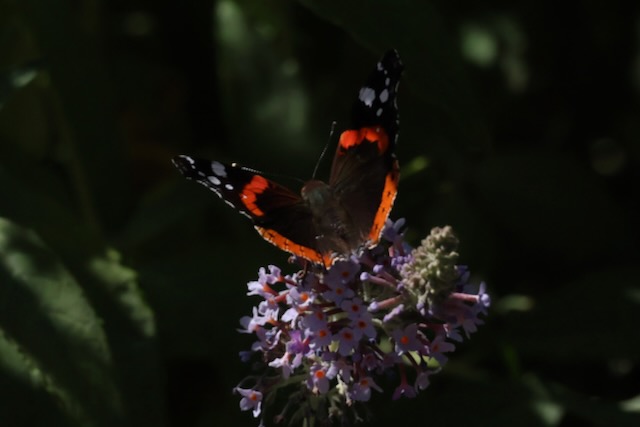

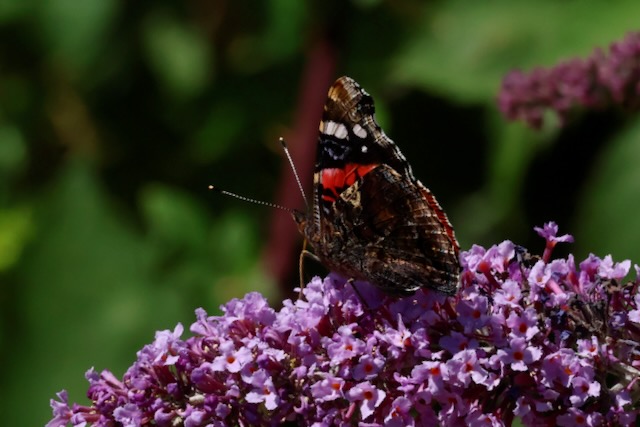

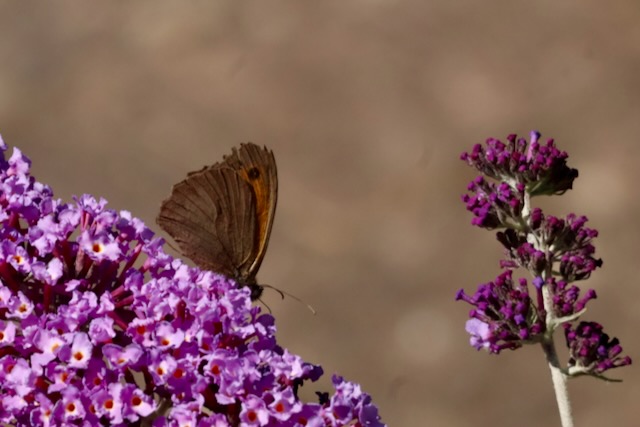
The Red Admiral looks good. I also saw Peacocks and Painted Ladies. The bottom one may be a Meadow Brown. I think so.


Comments